

Who Keeps the Whole Structural Design in View
Design leads, specialist designers, clients and project managers
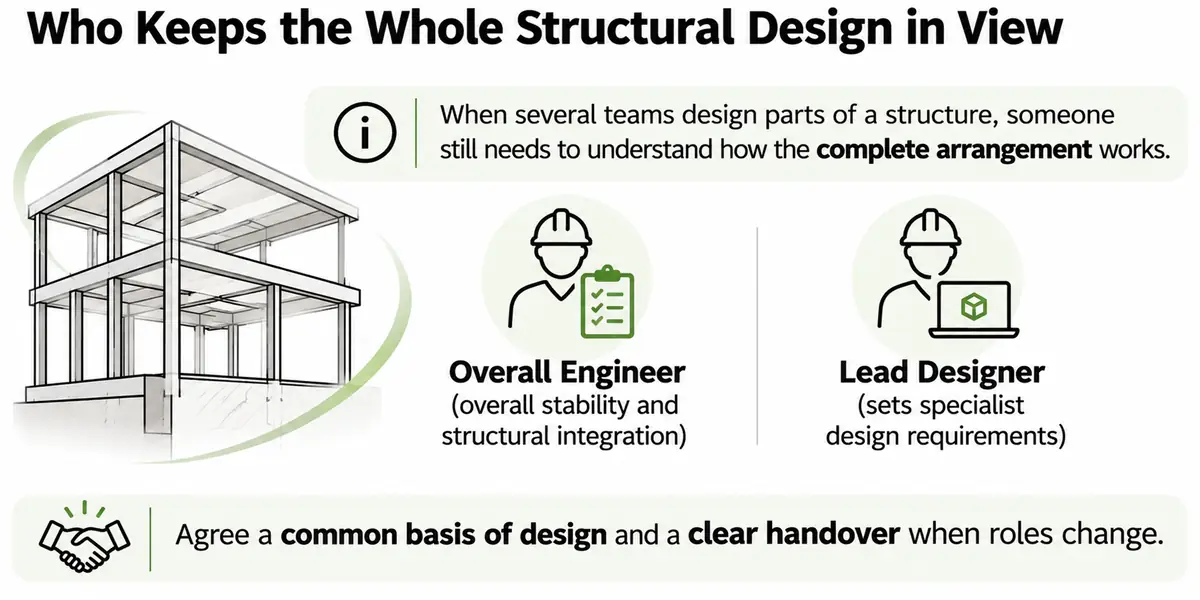
When several teams design parts of a structure, someone still needs to understand how the complete arrangement works. Identify the engineer responsible for overseeing overall stability and the lead designer who sets the specialist design requirements. Agree a common basis of design and a clear handover when roles change.
For a building project requiring structural design, explore our structural and foundation design. An article cannot determine the cause or appropriate solution for an individual property.
A contact list does not describe the structural interfaces
The lead structural designer needs to define what each specialist-designed part must do within the overall structure, including steel connections or precast units. Use consistent design requirements and assumptions; compatibility cannot be assumed simply because each team has designed its own part.
Trace how vertical and horizontal loads pass through the structure and which elements provide stability to others. For example, if a concrete core stabilises a steel frame, make that relationship explicit. A drawing that shows both systems does not itself explain what each relies on, especially during installation.
Temporary works designers, permanent works designers and proprietary suppliers need a clear way to resolve issues with one another and with the site team. Poor communication can contribute to failures, but failures usually have more than one cause. Coordinate the changing construction arrangement as well as the finished structure.
Give separate teams a common design basis
Agree a basis of design with the relevant parties and revisit it as the design develops. Explain the proposed approach to analysis, design and detailing. Identify a structural form that works in use and can be built without undue site risk.
The brief may contain uncertainty about intended use, loads or other requirements. Identify the missing information and request it. If it cannot yet be obtained, agree and record the bounds of the design assumptions and who will verify them. These are professional assumptions, not client-selected safety allowances. Under a tight programme, a simple and robust concept may be more feasible than an elaborate one.
Have specialist designers state their own design basis so it can be checked against the overall approach. In one reported UK industrial project, different reference levels for adjoining facilities nearly caused a serious error. Check even basic shared information across design packages.
Deal explicitly with the end of a concept appointment
A concept designer may leave when work passes to a fabricator or constructor. This can interrupt direct communication and leave important details unresolved. The incoming party may also take on a concept whose limitations it has not yet understood.
When that appointment ends, formally hand over the overall role to someone competent to accept it. Explain the structural concept, stability arrangements and unresolved assumptions so that the overall design remains understood.
Allocate risks to parties able to manage them, but do not treat that principle as a universal legal rule. Australian contractual and statutory responsibilities depend on the project. Reviewing another party's submission does not by itself transfer liability.
Keep the overview through changes and construction
Feed revisions from other disciplines, such as changed dimensions, loads or installation requirements, back into the structural design process. Control revisions so superseded information does not reach the site, and keep reliable as-built records so later changes can be assessed against what was actually built.
Use team discussions to resolve clashes and agree which systems rely on others during construction. Carry essential risk information onto the drawings and other records used on site. A meeting that produces no usable design information leaves the interface unresolved for site staff.
Check whether the overall design role remains active when the team changes, a specialist develops a detail or construction reveals an unexpected condition. Keep designers involved as needed and check that the work follows the design intent. A project contact list cannot do that job.
Questions for the Project Team
- Identify who keeps the overall stability of the structure in view and who sets the design requirements for specialists.
- Agree a common basis of design and tell the teams relying on it about significant uncertainties in the brief.
- Before a concept appointment ends, identify a competent recipient and arrange a formal technical handover of the overall role.