

Diagonal Cracks Near Windows Why the Whole Pattern Matters
Homeowners and buyers
A diagonal crack beside a window is noticeable because it cuts across an otherwise straight frame or wall. The opening is also a place where stresses can concentrate. That makes the surrounding pattern important: the crack's direction, taper, material and continuation elsewhere are clues to record, not a ready-made diagnosis.
If cracking or movement is affecting your property, explore our investigation of cracking and building movement. An article cannot determine the cause or appropriate solution for an individual property.
Why openings appear in crack patterns
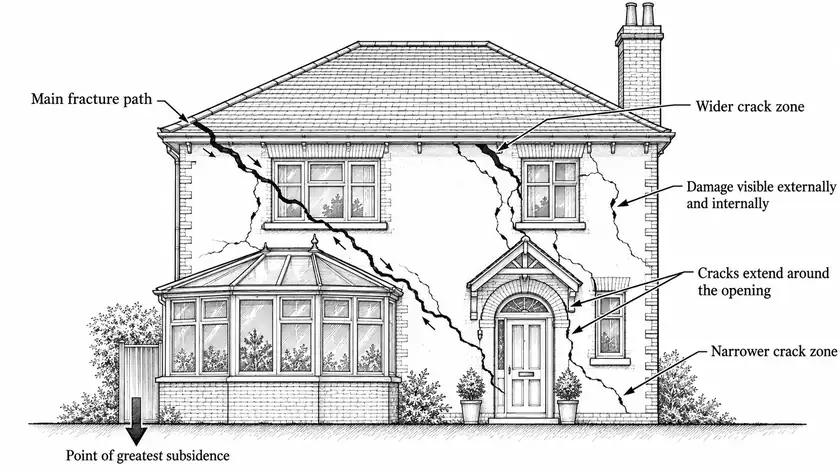
Openings can become part of a connected crack pattern. A crack can reach one side of a window and continue elsewhere around it rather than pass through uninterrupted masonry. Photograph above, below and beside the opening, then include the whole elevation or internal wall.
The illustration shows typical patterns, not rules for every building. Construction, restraint, loading and earlier repairs can change where cracks appear. A lining and brick veneer need not crack along the same line. The engineer needs to know how the wall is built before interpreting the pattern.
Taper and position are useful observations
Note the crack's direction, whether it widens towards the opening, a corner or the upper edge, and where it stops. Record branches and whether the crack passes through bricks or follows mortar joints. A sketch can make those locations clearer.
Do not infer the direction of movement from the illustrations alone. More than one area can move, and several causes can contribute. Repairs can hide earlier parts of a crack, leaving only the latest visible segment.
Check the frame and nearby materials
Record gaps around the window, cracked finishes at other corners and changes in how it opens or closes. Note when those changes started. Do not force a stiff window or dismantle it. If the outside face is visible from ground level, photograph corresponding external damage separately.
A diagonal line can also be associated with movement in supporting timber or other parts of the structure. Thermal movement, creep, deterioration and poor detailing can also contribute to cracking. These alternatives explain why the shape alone is insufficient.
Give the engineer a connected record
Provide wide photos, close-ups with a scale, a sketch and dates of any repairs or changes in window operation. Ask whether the pattern warrants inspection or monitoring and whether supporting elements or drainage need investigation.
The practical benefit is a better targeted assessment. You are preserving the evidence of how the window and surrounding wall behave together, while leaving cause and significance to the professional examining the building.
Useful Next Steps
- Photograph the whole window opening and the wall around it.
- Show where the crack widens or branches and mark any known repairs.
- Note changes in window operation without forcing it.
- Record related internal and external observations only where safely accessible.