

Why Crack Width Alone Does Not Explain Building Movement
Homeowners and building professionals
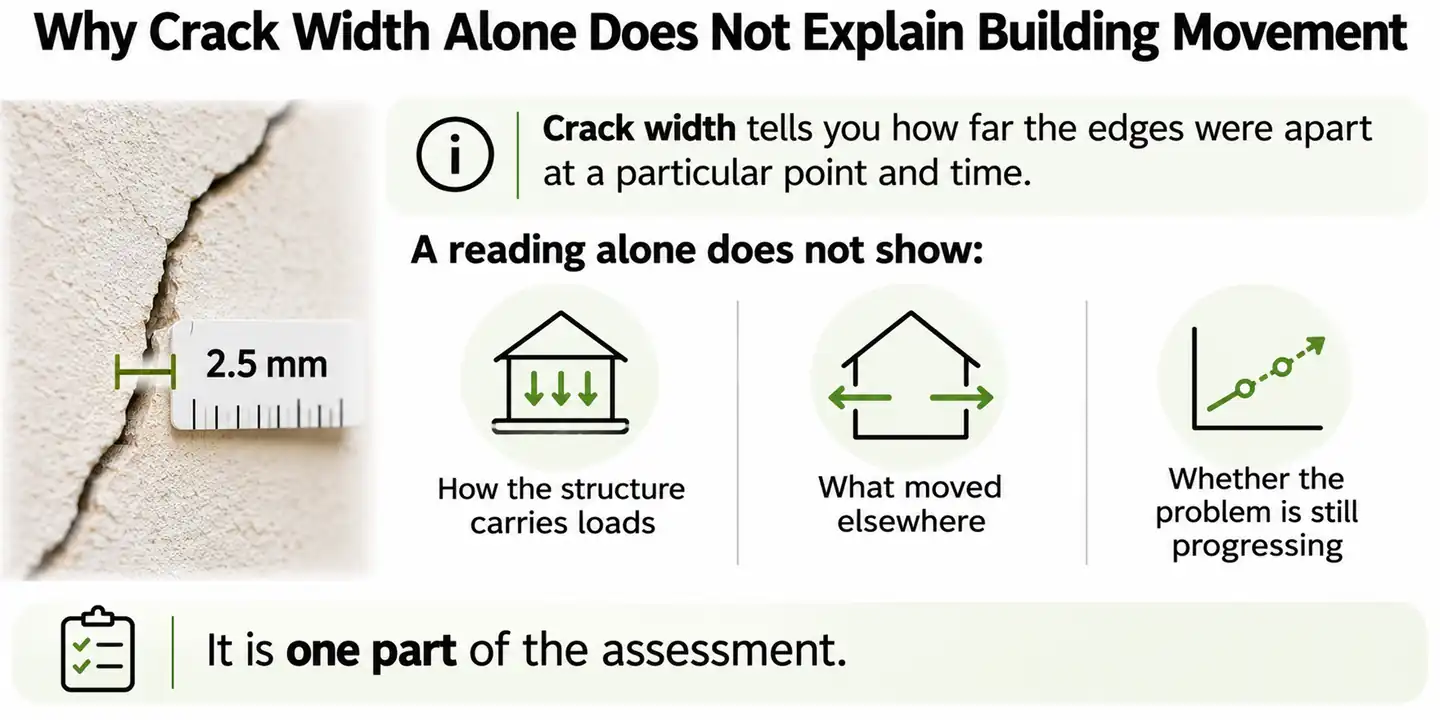
Crack width tells you how far the edges were apart at a particular point and time. A reading alone does not show how the structure carries loads, what moved elsewhere or whether the problem is still progressing. It is one part of the assessment.
If cracking or movement is affecting your property, explore our investigation of cracking and building movement. An article cannot determine the cause or appropriate solution for an individual property.
The surrounding questions change the meaning
The material, location and function of the cracked element matter. A crack in a decorative finish is not the same as a fracture affecting a supporting member. Nearby distortion, impaired weather resistance or a change in how a door operates may tell you more than width alone.
Consider approximate widths alongside descriptions of damage and repair considerations. Read them together. A width category is not a statement that a structure is safe.
Several cracks can share the movement
Distortion can be distributed across several cracks rather than one large opening. An isolated close-up can miss that pattern. Map the connected cracks and their positions on the elevation before focusing on one number.
The illustration shows an array as part of a wider structural pattern. It is intended to explain the need to examine the whole area. It is not a formula for a homeowner to calculate the cause or significance of an unrelated building's damage.
Trend and measurement quality matter
Compare readings taken at the same point using the same method. A coarse reading can miss changes too small for the tool to detect. Seasonal changes may also need a different interpretation from widths that keep increasing in the same direction.
Instrumented monitoring can help establish whether significant movements have ceased before some repairs. Those conclusions rely on suitable evidence and professional interpretation, not on choosing a reassuring number from a chart.
Keep dimensions as observations
Record the point, date, tool and method for each reading. Note if the edges are irregular or the width is approximate. Include the crack length, any branches, related symptoms and photographs so the engineer can interpret the measurements.
A structural damage assessment can consider the wider system and the likely mechanism. Escalate visible instability urgently whether or not the crack has been measured.
Useful Next Steps
- Keep the measurement point and method with every width reading.
- Map related cracks, distortion and changes in how nearby elements function.
- Read the classification descriptions and qualifications alongside the numbers.
- Seek an assessment instead of relying on crack width to decide whether the property is safe.