

What Can Structural Inspection Tools Measure and What Can They Not Prove?
Owners and building professionals
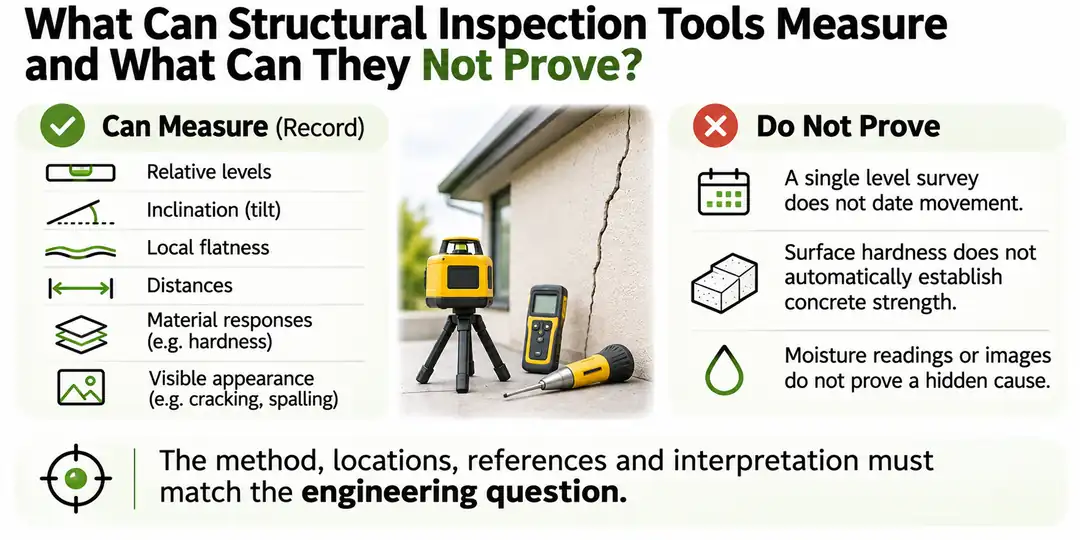
Structural inspection tools can record different quantities, including relative levels, inclination, local flatness, distances, material responses and visible appearance. Those outputs are not interchangeable. A single level survey does not date movement; surface hardness does not automatically establish concrete strength; and moisture readings or images do not prove a hidden cause. The method, locations, references and interpretation must match the engineering question.
For an on-site assessment of a specific building concern, explore our forensic site inspections. An article cannot determine the cause or appropriate solution for an individual property.
Before commissioning a test or survey, ask what evidence is missing, what the method actually measures and which decision it could change. More readings are not necessarily better evidence.
Separate the uncertainties first
Start with what the building needs to do and what drawings, inspections and service history already show. That evidence may be sufficient without testing. Uncertain materials, deterioration and changed loads call for different information and may require different tests.
For a concrete beam, measuring material strength, locating reinforcement and investigating internal defects are three different tasks. Asking to 'test the beam' does not specify what information is needed, where to test or how to interpret the results.
Some tests measure a property directly; others measure a response that needs calibration and interpretation. A rebound hammer compares surface hardness, and ultrasonic pulse velocity can help compare uniformity. Neither automatically provides a reliable strength for calculation. Cores provide material for strength testing and examination, with different costs and effects on the structure.
A rust stain or spall records a visible condition, not its cause. The engineer should identify which questions need answering and select evidence that can distinguish them. Concrete age or a single favourable result cannot fill every gap.
Know which quantity is being measured
Distinguish elevation, inclination, local flatness and dimensions. Keep the units, reference and exact measurement location with each result.
- Elevation is a point's level relative to an identified datum. A floor survey describes relative geometry across the building. A single survey cannot establish when that shape developed or whether it is still changing.
- Inclination describes orientation over the measured length in a particular direction. A short reading at one spot does not necessarily represent the slope of the whole room or wall.
- Local flatness describes departures over a defined span or from a reference plane. A straightedge gap is not an inclination reading. An evenly sloping surface and an uneven one can produce different patterns.
- A dimension is a distance between identified endpoints. Comparing diagonals can describe room geometry, but unequal diagonals do not show that the room was originally square or that it has moved.
Identify the surfaces and endpoints and note any instrument reference offset. A dimension to the face of skirting is not automatically a dimension to the wall behind it. Do not assume a ceiling is level.
Direction and contact also matter. Rotating an instrument, choosing different points or bridging a different length changes the observation. Averaging several short readings does not automatically create a valid whole-surface result. The professional method needs to suit the question and make any limitations clear.
A sensor response or image still needs interpretation
A moisture meter gives an indirect reading on a particular scale and mode. Interpret it in light of the material, calibration and location. A high reading alone does not identify a leak source or show the condition of concealed timber.
Photographs and drone images record what was visible and can guide closer inspection. They do not show concealed fixings or connections. Dimensional measurements require an appropriate survey method, references and checks; sharp images alone are not proof of accuracy.
Ease of operation does not make an output self-explanatory. Ask whether the equipment's calibration, procedure and limitations suit the particular construction. A manufacturer's capability statement for one arrangement should not become a general promise about every building or material.
Choose locations that can answer the question
Results from convenient locations may miss the part that controls the decision. Sampling needs to consider likely variation, critical areas, deterioration and the volume of material each method examines. A result from a small zone cannot simply describe the whole building.
Start with an agreed, useful scope and review whether to extend it after assessing the first results. Retain the full reports and underlying data from earlier tests, as summaries may omit locations, procedures, calibration or qualifications.
Compare repeated measurements only on an appropriate common basis. A different surface, reference or procedure can change the reading without underlying movement, even if the same kind of instrument was used.
Agree what will happen after the result
Discuss safe access, disruption to occupants, sampling, making good and interpretation before work starts. Plan for the safety of building users and the testing team. Owners can provide history and practical restrictions; the engineer should agree the programme and coordinate competent specialists.
If there is urgent danger, seek prompt professional advice and involve emergency services or utilities where appropriate. Do not wait to arrange testing or try intrusive sampling, roof access or load testing yourself.
Ask what would happen after a favourable, unfavourable or inconclusive result. If the same action follows every result, ask what useful evidence the test would add. An inconclusive result may call for a different method, a qualified conclusion or better information before proceeding.
Keep the locations, method, references and interpretation with the result. A number on its own is hard to assess, especially if it is described as a pass or fail without stating the criterion.