
Crack Gauges Tell Tales and Callipers What Each Records
Homeowners and inspection professionals
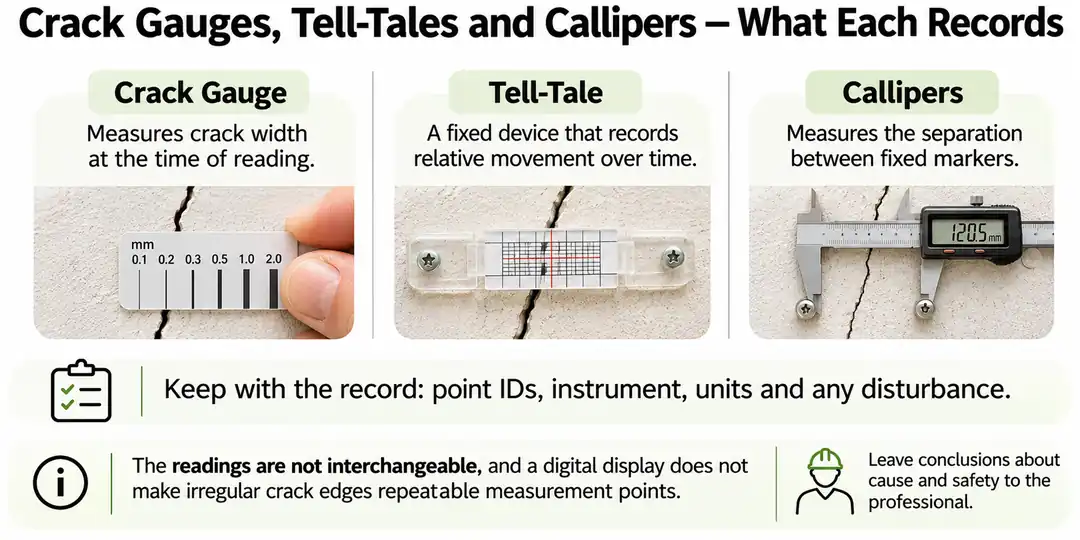
A hand-held gauge measures crack width, a fixed tell-tale records relative movement, and callipers between fixed markers measure their separation. The readings are not interchangeable, and a digital display does not make irregular crack edges repeatable measurement points. Keep the point IDs, instrument, units and any disturbance with the record. Leave conclusions about cause and safety to the professional interpreting it.
If cracking or movement is affecting your property, explore our investigation of cracking and building movement. An article cannot determine the cause or appropriate solution for an individual property.
Agree what the monitoring should establish and the precision it needs before choosing a device. Its fixing points, surface condition, calibration and recording method affect the result. Choose the approach with the professional who will interpret it.
A tell tale records relative displacement
Calibrated tell-tales span a crack. Their readings reflect relative movement between fixed parts. Installation needs to suit the surface and expected movement; a loose fixing can create an apparent change unrelated to the crack. The hand-held comparison gauge shown here serves a different purpose.
Record the exact gauge location and baseline reading as well as the crack ID. Photograph the installation. If the device is knocked, removed or refitted, do not treat the series as uninterrupted.
Callipers use repeatable fixed points
Digital callipers can measure the separation between fixed markers. With equipment and procedures suited to the required precision, the markers let you measure the same separation each time.
Putting calliper jaws into an irregular crack at slightly different points does not measure the same thing each time. The digital display can still make the result look precise.
The record needs method and limitations
Keep dates, units, point IDs, instrument details and any disturbance with the readings. Flag failed or uncertain readings. Do not assume that an uncalibrated homeowner setup achieves the accuracy of a calibrated professional setup.
Do not improvise with brittle glass across a crack. Where instrumented monitoring is needed, ask for a suitable device and a safe installation.
Interpretation is wider than the display
A change can be progressive, seasonal or an effect of the setup. Compare the readings with other evidence and the professional's review plan. The gauge cannot decide cause, safety or repair scope on its own.
If a tell-tale loosens after repainting, record it as a disturbance rather than a sudden movement reading. If other symptoms suggest genuine change, arrange review while the equipment issue is resolved.
Useful Next Steps
- Agree the monitoring question, method and precision before installation.
- Photograph the fixed points and keep the starting reading.
- Note repainting, knocks, removal and readings you are unsure of.
- Have an appropriately experienced professional interpret the readings.