
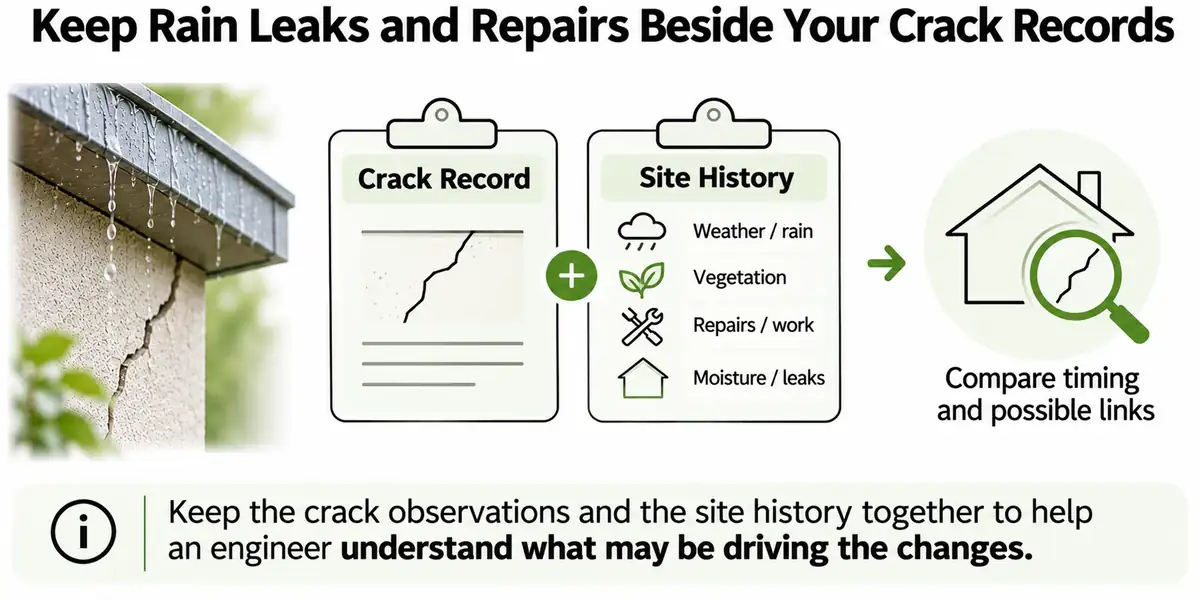
Keep Rain Leaks and Repairs Beside Your Crack Records
Homeowners and property managers
Keep the crack observations and the site history together. This lets an engineer compare the timing of changes with weather, moisture, vegetation and building work without having to reconstruct events months later.
If cracking or movement is affecting your property, explore our investigation of cracking and building movement. An article cannot determine the cause or appropriate solution for an individual property.
Record events not conclusions
Use specific entries such as 'downpipe overflow photographed', 'plumbing leak repaired' or 'tree pruning completed'. Record the date and location, link any photo or document and distinguish what you saw from what others reported.
Record the timing and conditions rather than writing 'rain caused the crack'. A possible link is a question for the engineer to investigate, not a conclusion from the log.
Connect events to the same issue IDs
Cross-reference crack IDs where an event may be relevant, without assuming it caused movement. Record the area actually affected. Include excavation, paving, irrigation and changes to drainage as well as weather.
For example, a hypothetical owner notices C01 widening during a dry period while C02 remains apparently unchanged. The different responses are useful. A general entry that "all cracks worsened in drought" would lose that distinction.
Be honest about weather information
Distinguish an observation of heavy rain from a measured total. If you use weather station data, name the source and remember it does not tell you how much water reached a particular footing. No rainfall threshold here establishes cause.
From a safe position, note what happened on site: ponding, overflow, water discharging towards the building or a newly wet area. These observations can be more useful than a regional rainfall description alone.
Use the timeline to improve questions
Check whether changes recur, persist after repair or affect other locations. Ask the engineer which events warrant investigation and what extra information would help. The sequence of events does not prove responsibility.
Keep the timeline concise, with dated entries linked to photos and reports. It can save time reconstructing the history but does not replace the investigation the building needs.
Useful Next Steps
- Date and locate each event and link its supporting evidence.
- Keep direct observations, reports from others and interpretations distinct.
- Cross-reference individual issues without assuming what caused them.
- Keep records of both changes and observations that appear unchanged.